
Travelling with Mounjaro: Storage, Cooling and Flying Guide for Australian Travellers
What temperature should Mounjaro be stored at?
The Australian Consumer Medicine Information states that the Mounjaro KwikPen should normally be stored in a refrigerator between 2°C and 8°C.
Mounjaro should also:
- Remain in its original packaging to protect it from light;
- Be handled carefully because the KwikPen contains glass components;
- Never be frozen;
- Not be used if it has been frozen.
When refrigeration is unavailable, the Mounjaro KwikPen may be kept at room temperature below 30°C for up to a total of 30 days.
Mounjaro storage summary
| Storage Requirement | Australian Guidance |
|---|---|
| Normal refrigerated storage | Between 2°C and 8°C |
| Temporary unrefrigerated storage | Below 30°C for up to a total of 30 days |
| Protection from light | Keep the KwikPen in its original packaging |
| Freezing | Do not freeze or use after freezing |
| Physical protection | Handle carefully because the KwikPen contains glass parts |
| After the fourth dose | Discard the KwikPen after the final dose |
Always follow the current Consumer Medicine Information supplied with your medication and the advice of your doctor or pharmacist.
Choosing a Medactiv transport option
Once you understand the published storage requirements for your medication, the next step is choosing a transport option that can support those requirements for your complete journey.
Medactiv provides medication cooling solutions for short local trips through to long-haul international travel.
| Travel Requirement | Possible Medactiv Option |
|---|---|
| Protection from heat while the medication is outside refrigeration | EasyBag Classic |
| Up to 12 hours between 2°C and 8°C | iCool Weekender |
| Up to 24 hours between 2°C and 8°C | iCool Prestige |
| Up to 36 hours, small-to-medium quantity | iCool MediCube Compact |
| Up to 36 hours, larger quantities or cartons | iCool MediCube Ultra |
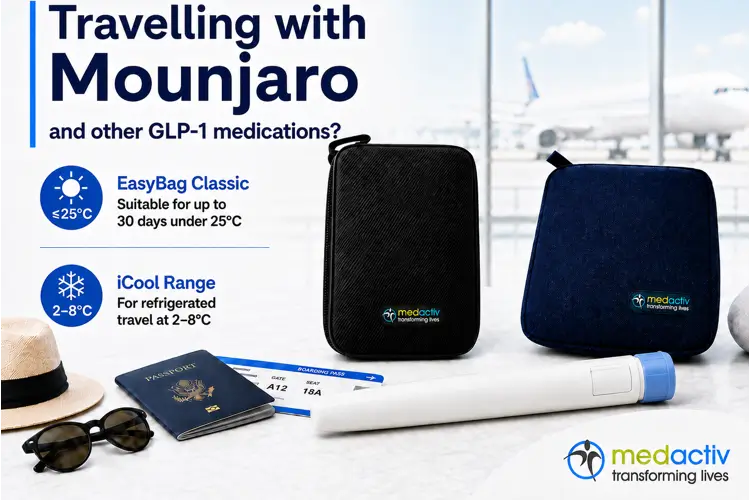
The EasyBag Classic provides cooling between approximately 16°C and 25°C for up to five days and does not refrigerate medication between 2°C and 8°C.
At an ambient temperature of approximately 24°C, Medactiv testing found that the iCool Weekender, iCool Prestige and iCool MediCube ranges maintained medication between 2°C and 8°C for approximately 12, 24 and 36 hours respectively.
Higher surrounding temperatures may reduce the available cooling duration.
EasyBag Classic — cooling protection for up to five days
The EasyBag Classic may be considered when Mounjaro is being carried within its permitted unrefrigerated storage period and needs protection from excessive heat.
The EasyBag Classic is activated using fresh water and is designed to maintain medication between approximately 16°C and 25°C for up to five days, depending on the surrounding conditions.
It does not refrigerate medication between 2°C and 8°C.
The EasyBag Classic may suit:
- Travel during the permitted unrefrigerated period;
- Protection against temperatures rising above 25°C;
- Shorter trips where refrigerated transport is not required;
- Day trips and sightseeing;
- Transfers between a hotel and airport;
- Warm-weather travel;
- Destinations where fresh water is available but freezer access is limited.
The EasyBag Classic should only be used when the medication is being stored in accordance with its permitted unrefrigerated conditions.
Confirm with your pharmacist that this approach is appropriate for your medication and travel period.
iCool Weekender — up to 12 hours
The iCool Weekender may suit:
- Local travel;
- Protection against temperatures rising above 25°C;
- Day trips;
- Shorter domestic flights;
- Travel between two reliable refrigerators;
- A small quantity of medication.
iCool Prestige — up to 24 hours
The iCool Prestige may suit:
- Domestic air travel;
- Day trips;
- Shorter international flights;
- A small number of KwikPens;
- Journeys where reliable refrigeration will be available within 24 hours.
Measure the Mounjaro KwikPen and its original packaging before purchase to make sure it will fit.
iCool MediCube Compact — up to 36 hours
The iCool MediCube Compact may suit:
- Long-haul travel from Australia;
- Journeys exceeding 24 hours;
- Extended airport stopovers;
- Several Mounjaro KwikPens;
- Medication kept in its original packaging.
The Compact maintains medication between 2°C and 8°C for up to 36 hours under its stated testing conditions. Its listed internal cavity is approximately 70 mm × 175 mm × 140 mm.
iCool MediCube Ultra — larger capacity for up to 36 hours
The iCool MediCube Ultra provides additional capacity for:
- Multiple Mounjaro cartons;
- Longer trips;
- Several weeks or months of medication;
- More than one refrigerated medicine;
- Bulky original packaging.
The Ultra is designed to maintain medication between 2°C and 8°C for up to 36 hours. Its usable internal space is approximately 21 × 14 × 12.5 centimetres.
A medication cooler should not be selected solely according to the medication name. The correct option depends on the complete journey, medication quantity and packaging dimensions.
Does Mounjaro need to remain refrigerated while travelling?
Not necessarily in every situation.
The Australian Consumer Medicine Information permits the Mounjaro KwikPen to remain outside refrigeration for up to a total of 30 days, provided it remains below 30°C.
This may be suitable for a shorter trip when:
- The complete period is within the permitted 30 days;
- The medication can reliably remain below 30°C;
- It will remain protected from light and excessive heat;
- Your pharmacist confirms that the plan is appropriate.
When Mounjaro is being carried within its permitted unrefrigerated period, the EasyBag Classic may provide an additional layer of protection against warm conditions by helping maintain temperatures between approximately 16°C and 25°C.
The EasyBag Classic is a cooling pouch rather than a refrigerated 2°C to 8°C transport solution.
Temperatures can exceed 30°C:
- Inside a parked vehicle;
- in direct sunlight;
- During an outdoor airport transfer;
- Inside a coach or bus luggage compartment;
- In tropical destinations;
- During Australian summer travel.
A standard handbag, backpack or insulated lunch bag does not necessarily maintain a controlled temperature.
For long-haul journeys, hot destinations or travel where temperatures cannot be reliably controlled, maintaining Mounjaro between 2°C and 8°C may provide a more predictable storage plan.
Does the 30-day period need to be continuous?
The Australian Consumer Medicine Information states that Mounjaro may be kept at room temperature for up to a total of 30 days when refrigeration is unavailable.
Because the wording refers to a total period, keep a written record of when the KwikPen first leaves refrigeration and any subsequent periods outside refrigeration.
Ask your pharmacist whether a KwikPen that has been temporarily stored at room temperature may be returned to refrigeration and how the total 30-day allowance should be recorded for your particular pen.
Calculate the complete door-to-door journey
Do not choose a medication cooler using only the scheduled flight time.
Your total travel period may include:
- Travel from home to the airport.
- International check-in.
- Security screening.
- Waiting at the departure gate.
- Flight time.
- Stopovers and connecting flights.
- Immigration and baggage collection.
- Ground transport to the accommodation.
- Time required to access suitable refrigeration.
A flight advertised as 22 hours may become a journey of 28 to 32 hours once airport waiting, transfers and delays are included.
For travel from Australia to Europe, the United Kingdom or North America, allow a reasonable buffer for delays.
Can you take Mounjaro on a plane?
Prescription medicines and medically required cooling items can generally be carried through Australian airport security.
Keep Mounjaro in your carry-on luggage, rather than checked baggage.
Checked baggage may be:
- Delayed or lost;
- In direct sunlight;
- Exposed to uncontrolled temperatures;
- Placed in very hot or cold environments;
- Damaged during handling;
- Unavailable during a missed connection.
Australian airport-security guidance allows reasonable quantities of prescription medicines and medically required temperature-control items. You may be required to present the medication, gel packs and evidence such as a doctor’s letter at screening.
Documents to consider carrying
Keep the following with your medication:
- Your prescription;
- A letter from your doctor;
- The pharmacy-labelled original packaging;
- The Consumer Medicine Information;
- A list of the medicines and injection equipment you are carrying;
- Confirmation that gel packs are required for temperature control.
The name on the prescription label should match the name on your boarding pass, or the person travelling in your care.
Check the requirements of the airline, departure airport, transit airports and destination country before travelling.
Can frozen gel packs go through airport security?
Frozen gel packs used to regulate the temperature of prescription medication can be carried as medically required items, but you may need supporting evidence.
Australian Government guidance strongly recommends carrying a doctor’s letter listing ice or gel packs used for medication temperature control.
Before departure:
- Carry your prescription and doctor’s letter;
- Present the medication and cooling equipment openly;
- Allow additional time for inspection;
- Check the rules at every airport on your itinerary.
Overseas airports may apply different procedures from Australian airports.
Can you fly with the Mounjaro KwikPen and needles?
Yes, provided the medication and injection equipment are medically required and appropriately documented.
If carrying hypodermic needles through Australian airport security, you must carry evidence such as a doctor’s letter showing that the needles are medically necessary. Present the needles and supporting documentation at the screening point.
Keep unused needles in their original packaging and carry an appropriate plan for disposing of used needles at your destination.
How to pack Mounjaro in an iCool bag
Always follow the instructions supplied with the selected Medactiv product.
General preparation includes:
- Freeze the Medactiv gel packs at approximately –18°C for at least 14 hours.
- Position the gel packs as shown in the product instructions.
- Use the internal protective divider.
- Never allow the Mounjaro KwikPen to directly touch a frozen gel pack.
- Keep the KwikPen in its original packaging where practical.
- Protect the KwikPen from impact and physical damage.
- Keep the cooler closed as much as possible.
- Protect the bag from direct sunlight and external heat.
The divider is important because medication requiring refrigeration can also be damaged by freezing.
The KwikPen contains glass components, so it should also be packed carefully to prevent drops and impacts. The Australian CMI states that a KwikPen dropped onto a hard surface should not be used.
What if the original Mounjaro carton does not fit?
Mounjaro should remain in its original packaging to protect it from light.
When possible, choose a medication cooler large enough to accommodate the original packaging.
When space is limited:
- Ask your pharmacist before removing the KwikPen from its carton;
- Keep the pharmacy label and prescription with the medicine;
- Protect the KwikPen from light;
- Use suitable padding to prevent impact;
- Ensure the KwikPen cannot touch frozen gel packs.
The MediCube Ultra may be more suitable when several original cartons need to be transported.
Protecting the Mounjaro KwikPen from damage
The Mounjaro KwikPen contains glass parts and should be handled carefully.
If the KwikPen is dropped onto a hard surface, the Australian CMI advises not to use it. The damaged pen should be appropriately discarded and replaced with a new one.
During travel:
- Keep the KwikPen in a protective case;
- Do not place heavy objects on top of it;
- Prevent it from moving freely inside the cooler;
- Keep it in your carry-on luggage;
- Inspect it after any significant impact.
Will airline staff refrigerate Mounjaro?
Do not rely on airline staff to refrigerate your medication; they will not.
Aircraft refrigerators are intended for catering supplies and are not available for passenger medication. Their temperatures may also not be monitored within the required 2°C to 8°C range.
Your travel plan should allow you to manage the medication throughout the journey without relying on cabin-crew refrigeration.
Managing stopovers
A stopover can significantly increase the time away from reliable refrigeration.
Before travelling, check:
- The stopover duration;
- Whether you will remain airside;
- Whether an airport hotel is available;
- Whether refrigerator access is available;
- Whether freezer access is available for the gel packs;
- Whether the selected cooler covers the complete journey.
Do not assume that airport restaurants, lounges or airline staff will store medication or refreeze gel packs.
For an overnight stopover, contact the hotel before arrival and ask separately about:
- refrigerator access for the medication;
- freezer access for the gel packs.
Using a hotel refrigerator
Hotel minibars and small refrigerators may have inconsistent temperatures.
Medication placed against the back wall or cooling plate may freeze. A frequently opened or heavily stocked refrigerator may not remain cold enough.
When using hotel refrigeration:
- Ask whether the refrigerator maintains 2°C to 8°C;
- Keep the medicine away from the back wall and cooling element;
- Leave it in its original packaging;
- Place it where it will not be accidentally removed;
- Advise hotel staff that it is prescribed medication;
- Consider using a suitable thermometer.
Travelling during an Australian summer
To reduce heat exposure:
- Never leave Mounjaro or the cooler in a parked vehicle;
- Keep it out of direct sunlight;
- Carry it inside the passenger cabin of the car;
- Do not place it in a bus luggage compartment;
- Minimise time outdoors during transfers;
- Keep the cooler with you.
Higher ambient temperatures may reduce the stated performance duration of a medication cooler.
What should you do if Mounjaro becomes too warm?
Do not decide whether temperature-exposed medication is usable based only on its appearance.
Record:
- The estimated highest temperature;
- How long the exposure lasted;
- Whether the KwikPen remained in its original packaging;
- Whether it was exposed to direct sunlight;
- How much of the permitted 30-day unrefrigerated period had already been used.
Contact your pharmacist, prescribing doctor or the manufacturer for medicine-specific advice.
What should you do if Mounjaro freezes?
The Australian Consumer Medicine Information states that the Mounjaro KwikPen must not be frozen and must not be used if it has been frozen.
If you believe it has frozen:
- Do not use it;
- Do not thaw it and continue using it;
- Keep it separate from unaffected medication;
- Contact your pharmacist;
- Arrange safe disposal if advised.
When should a Mounjaro KwikPen be discarded?
The Mounjaro KwikPen contains four prescribed doses.
The Australian CMI states that the pen should be discarded after the fourth and final injection, even though a small amount of liquid may remain. That remaining medicine is normal and should not be used as an additional dose.
Dispose of the KwikPen in a yellow sharps container or another suitable puncture-resistant container, according to your pharmacist’s instructions.
Frequently asked questions
What temperature should Mounjaro be stored at?
Mounjaro KwikPen should normally be refrigerated between 2°C and 8°C.
When refrigeration is unavailable, it may be kept below 30°C for up to a total of 30 days.
Does Mounjaro always need refrigeration while travelling?
Not always. The temporary unrefrigerated allowance may suit some journeys when the medication can reliably remain below 30°C.
The EasyBag Classic may help protect it from temperatures above 25°C while it is being carried within the permitted unrefrigerated period.
Ask your pharmacist which approach is appropriate for your circumstances.
Can the EasyBag Classic be used for Mounjaro?
The EasyBag Classic may be considered when Mounjaro is being carried within its permitted unrefrigerated storage period.
It is designed to help maintain medication between approximately 16°C and 25°C for up to five days. It does not provide refrigerated transport between 2°C and 8°C.
Confirm with your pharmacist that unrefrigerated storage is appropriate for your circumstances.
Can Mounjaro be carried in hand luggage?
Temperature-sensitive medication should generally remain in your carry-on luggage so that it stays accessible and avoids the uncontrolled conditions that can occur in checked baggage.
Can Mounjaro touch a frozen gel pack?
No. Use the protective divider supplied with the medication cooler. Direct contact with a frozen gel pack may cause the medication to freeze.
Which Medactiv cooler may suit travel to Europe?
For long-haul travel from Australia, the iCool MediCube Compact may suit a small-to-medium quantity requiring up to 36 hours of refrigerated transport.
The iCool MediCube Ultra provides additional capacity for several cartons or other refrigerated medication.
The appropriate option depends on the complete door-to-door journey and packaging dimensions.
Can an ordinary insulated lunch bag be used?
An ordinary insulated bag may offer temporary protection from direct heat, but it is not necessarily designed or tested to maintain medication within a defined temperature range.
Can a Mounjaro KwikPen be used after being dropped?
The Australian CMI states that if the KwikPen is dropped onto a hard surface, it should not be used because it contains glass components. Appropriately discard the damaged pen and use a new one.
Can you use the small amount left after the fourth dose?
No. The small amount remaining after the fourth injection is normal. The KwikPen should be discarded after the final prescribed dose.
Mounjaro travel checklist
Before leaving Australia:
- Read the current Consumer Medicine Information;
- Confirm your storage plan with your pharmacist;
- Determine whether you require refrigeration or protection from heat;
- Calculate the complete door-to-door journey;
- Check expected temperatures;
- Measure the KwikPen and original carton;
- Choose a cooling product with sufficient duration and capacity;
- Include additional time for delays;
- Correctly prepare the EasyBag or freeze the iCool gel packs;
- Obtain your prescription and doctor’s letter;
- Check airline and airport-security requirements;
- Keep Mounjaro in your carry-on luggage;
- Protect the glass-containing KwikPen from impact;
- Organise suitable refrigeration at the destination;
- Arrange freezer access if the gel packs need to be reused;
- Carry a suitable sharps container.
Need help selecting a medication cooler?
Medactiv Australia can help you compare product capacity and cooling duration based on your complete travel time and medication quantity.
View the Medactiv medication cooling range or contact Medactiv Australia on 0410 022 777.
Important information
This article is intended for people who have already been prescribed Mounjaro. It provides general information about published storage and transport requirements.
Medactiv does not prescribe or supply Mounjaro. Medactiv products provide storage and transport support for prescribed temperature-sensitive medication.
Always refer to the current Australian Consumer Medicine Information and speak with your doctor or pharmacist before changing how your medication is stored or transported.
Medactiv Australia provides a range of iCool bags to help patients transport temperature-sensitive medication with confidence, whether it is for a short day trip, overnight stay, or longer journey.
Contact www.medactiv.com.au or use our online email form to travel with confidence.
ABOUT MEDACTIV
MedActiv is a global leader in the development of transport and storage solutions for sensitive medication. Our products are designed to give users the freedom to travel knowing that their medication is kept at exactly the right temperature. As the chosen partner of major pharmaceutical companies worldwide, MedActiv is constantly pushing back the boundaries of this industry.
Proudly based in Melbourne, Australia
Medactiv is a local Australian company, providing trusted medication cooling solutions with local support and service.
Our Address
7 McGahy Court
Templestowe VIC 3106
Australia
MedActiv North America www.medactiv.ca MedActiv Europe www.medactiv.com MedActiv South America www.medactiv.cl MedActiv Australia www.medactiv.com.au LifeIna Europe www.lifeina.com
FOLLOW US



Unauthorised duplication or publication of any materials from this Site is expressly prohibited.