

Travelling with AutoInflammatory Disease
Tips for navigating your journey
Travelling with Systemic AutoInflammatory Diseases can feel overwhelming, especially when balancing the excitement of new places with managing your health. For those living in Australia or New Zealand, planning an overseas trip involving biologic medications and other treatments requires extra preparation. With the right knowledge and a calm mindset, you can enjoy your adventures while keeping your health in check. Here’s a helpful guide to assist you.
What We’ve Learned About Travelling with Biologic Medications
Patients have shared their experiences over the years, and one thing stands out: preparation is crucial.
Understanding how to carry and store your medications, along with navigating different healthcare systems abroad, makes a significant difference. Keeping a detailed medication list, connecting with your healthcare team, and packing essentials can reduce stress and help you feel more in control.

Here are some tips to make your travel easier and safer:
1. Consult Your Healthcare Provider Before You Leave
Before booking your flight, check in with your specialist. They can guide you on managing your medications while travelling, provide necessary documentation, and discuss any adjustments for your treatment plan. Ensure they know your travel itinerary and time zone changes.
2. Prepare your medications and paperwork for travel
- Always keep your biologic medications and essentials in your carry-on. This way, you lower the risk of lost luggage and ensure you always have access to your treatments. This ensures you are prepared for any unexpected delays and can easily access it when needed.
- Original packaging only. Keep medications in their original packaging with clear labels for easy identification
- Bring a Doctor’s letter and Prescription. A letter from your healthcare provider clearly stating their name, business details and qualifications and your prescription can help explain your needs at security and customs, giving you peace of mind. Keep a copy of this letter and prescription on you and one with your medication
- Pack Extra Supplies. Bring extra medication and supplies in case of delays or lost luggage. It's better to have more than enough than to face unnecessary stress
- Declare Your Medication. Be open with security personnel about your medication. A calm explanation can make the process smoother and less stressful.
3. Understand Storage Requirements
Many biologic medications need refrigeration. Check if your destination has reliable refrigeration options, like hotel mini fridges. If not, talk to your healthcare provider about options such as portable coolers or ice packs that meet safety standards.
Medactiv and Lifeinabox have developed a range of solutions to keep your medicines at the right temperature at all times. These solutions are divided in two major technologies, which are cooler bags and mini fridges.
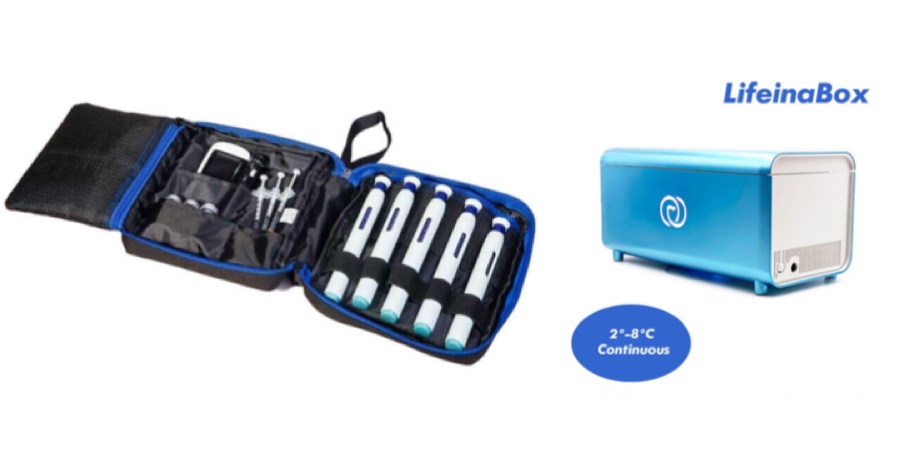
The iCool bags use a new generation of chemical ice packs that do not sweat and have a longer thawing point than traditional ice packs. The iCool bags can keep medication between 2 and 8°C for up to 36 hours, depending on the model chosen. They also include separate compartments for transporting your accessories. Available under both the MedActiv (iCool) and the Lifeina (LifeinaBag) brands, these bags are the perfect companion for longer trips.
To optimise temperature stability within your cooler or insulated bag, ensure there is sufficient space to accommodate additional foam spacers placed between your gel packs and medication. Creating an air gap through these spacers aids in maintaining a consistent temperature environment, thereby helping to preserve the integrity of your medication. Always keep your medications at the recommended temperature.
4. Carry a Detailed Medication List and Medical Letter
If you’re getting ready to travel, especially out of the country, make sure to bring a complete list of your medications. It is essential to have a letter from your doctor, something that lays out your treatment plan, what you take, how much, and any allergies you have.
If something happens and you need medical help, having all this handy means doctors can jump right in and take better care of you. It cuts down on mistakes and makes things way smoother.
Keep your medication list up to date. Jot down the names, dosages, and how you’re supposed to take everything. That way, you won’t forget anything important. There are also plenty of secure apps where you can store your medical history, allergies, meds, and emergency contacts. You never know when you’ll need that info on the go, so it’s good to have it right on your phone.
It is advisable to print out a fact sheet about your condition to have important information readily available when needed. This can be found on the ANZFAID website. In addition, having the Consumer Medicine Information (CMI) for your medication, which can be found on the TGA and Medsafe websites.
Basically, these records are your travel health safety net. They make getting help easier and let you relax a bit more while you’re away.
5. Be Aware of Time Zone Changes
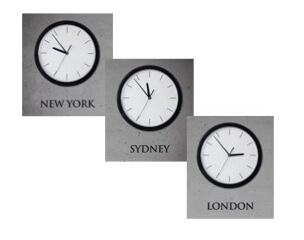 Adjusting to a new time zone can affect medication schedules. Plan ahead with your healthcare provider on how to shift your doses gradually if necessary. Set alarms or reminders to stay on track, especially for biologics that require precise timing.
6. Know the Healthcare System of Your Destination
Research how to access medical care while abroad. Know where hospitals, clinics, and emergency services are located. If you’re travelling to a country with language barriers, consider a translation app or a medical translation card that explains your condition and treatment.
Certain countries require you to disclose the details about any medication that you're bringing. Before you travel, it's a good idea to check the applicable regulations and rules to avoid being affected. Always travel with a prescription or other documentation from your doctor and keep the medication in its original container, and make sure you only travel with the amount you'll need for your trip.
In addition to potential limitations imposed by airlines, please consider that not all medications are available globally and some may be illegal. It is essential to verify their legality and availability, which might require using alternative transit points.
7. Pack Extra Supplies
Bring more medication than you think you'll need, just in case. Include extra syringes, needles, ice packs or infusion sets if applicable. Also, pack some basic first aid supplies and over-the-counter medications for common issues.
8. Stay Connected with Your Healthcare Team
Keep in touch with your healthcare provider during your trip if possible. Many clinics and hospitals offer international patient services. If you experience any health concerns, don’t hesitate to reach out for advice.
9. Your hotel
 There is no guarantee that your hotel room fridge or even it has one will be suitable for medication storage. Most hotels are happy to accommodate this, but not all.
If you need to freeze your ice packs when you arrive or before you leave, don’t count on the room fridge, it probably won’t get them cold enough. Skip the room fridge and ask someone at the hotel bar for help. They’ve got real freezers back there for their ice, so they can get your packs frozen solid.
10. Travel Insurance
If you’re living with an AutoInflammatory disease, getting the right travel insurance isn’t just a good idea, it’s a must. Before you pack your bags, dig into your policy and make sure it covers your condition. A lot of standard travel insurance plans either skip over pre-existing conditions or just give you the bare minimum, and that can really mess things up if you ever need to make a claim.
Keep copies of your insurance documents handy, don’t just leave them buried in an email somewhere. If something comes up, you’ll want them close. And before you go anywhere, check in with your doctor. Make sure your plans are safe and you’re not ignoring medical advice. Taking these steps lets you focus on your trip, not on what could go wrong.
11. Useful websites
It is important for travellers to visit the government safe travel pages that they can understand risks like political instability, crime, and health hazards, which directly impact their safety. Safe travel websites provide authoritative and up-to-date information on probable hazards, localised specific hazards, and necessary precautions to ensure safety, which allow visitors to make informed decisions on their destination for travel.
https://www.smartraveller.gov.au
https://www.safetravel.govt.nz
11. Useful websites
As someone who has several rare conditions, including an AutoInflammatory disease, I have found the single most useful tip for travelling by air through airports is to gain a Sunflower lanyard.
We've all seen people wearing these during the pandemic, but it is not widely known that the UK has been doing it since 2016. The Sunflower lanyard scheme was launched at Gatwick Airport because the Accessibility Team understood how challenging airports are for visitors with unseen conditions. A lanyard can help you explain that you have an unseen disability, be it a chronic illness like an AutoInflammatory disorder, a mental health condition like anxiety, a learning difficulty, or a neurological disorder like autism. It's a simple way to make your journey smooth and find the support and empathy you need.
To travel in Australia or even around the world with a Sunflower lanyard, wear it to subtly notify staff that you may need extra assistance due to an invisible disability, then state clearly what you need.
Pre-booking your assistance with your airline, especially for mobility needs, and checking if your airport has assistance initiatives, such as sensory maps, is best. If you need help, visit airport staff or assistance points, and they might be in a position to help by slowing things down, finding a quiet space, or offering reassurance.

Finally......
Travelling with an AutoInflammatory disease is a journey full of learning and resilience. Many patients have found that with careful planning, they can safely explore the world and create wonderful memories. Remember, you are not alone. Connecting with others who understand your experience can be empowering.
Whether you’re heading to Europe, Asia, or anywhere beyond our shores, take these tips to heart. Trust your preparation, lean on your healthcare team, and embrace the adventure ahead.
The world is waiting, and your story continues, stronger and more inspiring than ever. Safe travels!
__________________________________________
Systemic AutoInflammatory Diseases (SAIDs) are a rare group of disorders that affect fewer than 5 in 10,000 people. They have been recognised as a distinct disease category over the past 25 years. While there is some overlap, SAIDs differ from autoimmune diseases. SAIDs primarily involve the innate immune system, which is the body's first line of defence. In contrast, autoimmune diseases involve the adaptive immune system.
ANZFAID.org is a dedicated support service for people living with systemic autoinflammatory diseases in Australia & New Zealand. We are a volunteer run, not for profit organisation with a mission to bridge the gap between patients, their families and the medical community through information, education and collaboration.
____________________________________________________
Acknowledgment
ANZFAID acknowledges the Traditional Custodians of Country on which we live and work. We recognise their connections to land, water, and community. We pay our respects to Elders past, present and emerging. This land is, was, and always will be Aboriginal and Torres Strait Islander land. We acknowledge the rich diversity of our community.
As a bi-national organisation, we also acknowledge Māori as tangata whenua and Treaty of Waitangi partners in Aotearoa New Zealand.
We recognise and welcome the contribution, life experience and wisdom of people of all ages, from culturally, ethnically and linguistically diverse backgrounds, the LGBTIQA+ community, those with lived experience of disability, chronic health conditions including mental health, and the lived experience of carers.
____________________________________________________
Medical Disclaimer
The information and support services provided by Australia and New Zealand Forum for AutoInflammatory Diseases Limited (hereafter known as ANZFAID), are intended for general information and peer support purposes only. ANZFAID is a not-for-profit organisation and does not provide medical, diagnostic, or therapeutic advice or treatment.
Nothing on our website, in our publications, at our events, or in any of our communications should be taken as medical advice, nor is it intended to replace consultation with a qualified healthcare professional. Always seek the guidance of your doctor or another qualified health professional with any questions you may have regarding your health or a medical condition.
ANZFAID does not endorse or recommend any specific healthcare provider, treatment, medication, or service. Information shared through our organisation—whether by staff, volunteers, or community members— should not be considered a substitute for professional medical advice.
Use of our services and materials is at your own discretion and risk. While we aim to provide accurate and supportive information, ANZFAID accepts no liability for any loss or damage suffered as a result of reliance on information provided.
All materials contained within our website are subject to copyright and MUST NOT be copied or shared unless in their entirety and with relevant links in place to direct back to the original source on this website.
ABOUT MEDACTIV
MedActiv is a global leader in the development of transport and storage solutions for sensitive medication. Our products are designed to give users the freedom to travel knowing that their medication is kept at exactly the right temperature. As the chosen partner of major pharmaceutical companies worldwide, MedActiv is constantly pushing back the boundaries of this industry.
Proudly based in Melbourne, Australia
Medactiv is a local Australian company, providing trusted medication cooling solutions with local support and service.
Our Address
7 McGahy Court
Templestowe VIC 3106
Australia
MedActiv North America www.medactiv.ca MedActiv Europe www.medactiv.com MedActiv South America www.medactiv.cl MedActiv Australia www.medactiv.com.au LifeIna Europe www.lifeina.com
FOLLOW US



Unauthorised duplication or publication of any materials from this Site is expressly prohibited.